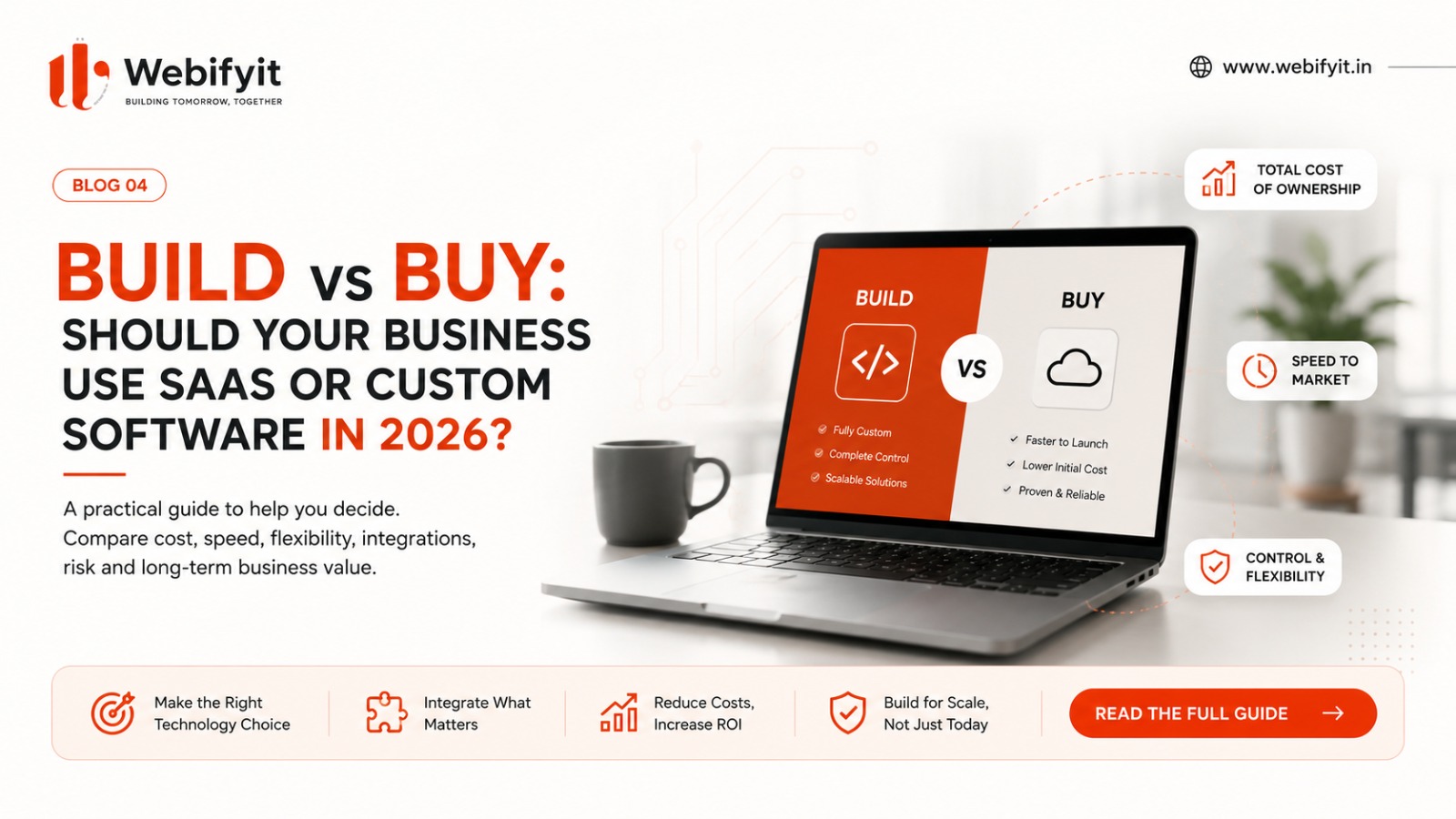
There is a question we probably should ask before writing a single line of code:
Do we actually need to build this?
It's an important question because custom software sounds attractive.
You can design everything exactly the way you want.
You control the workflow.
You can add whatever features you need.
You own the product.
Sounds great.
Until the project starts taking months, the requirements keep changing, integrations become complicated, and the “simple internal tool” somehow turns into a full software platform.
On the other side, buying a SaaS product is easy.
You sign up.
You pay.
You start using it.
But then you discover that the workflow doesn't quite match your business.
So you start adding workarounds.
Then another tool.
Then another integration.
Then another spreadsheet.
Eventually your team is spending more time connecting software than actually using it.
So which one is better?
The honest answer is:
It depends on the problem you're solving.
Sometimes you should buy.
Sometimes you should customize.
Sometimes you should build.
And sometimes the smartest decision is to do none of them yet.
The three choices
Most businesses are really choosing between three options:
1. Buy
Use an existing SaaS product.
2. Customize
Take an existing system and connect or extend it.
3. Build
Create a custom software solution around your exact workflow.
The mistake is treating this as a technology decision.
It is primarily a business decision.
When buying SaaS makes sense
SaaS is usually the best option when your business needs something that is already relatively standard.
For example:
- accounting
- email marketing
- project management
- standard CRM
- team communication
- payroll
- video meetings
- basic customer support
If your process looks like thousands of other companies, there is a good chance you shouldn't build software for it.
Why spend months building an internal project management system when a mature SaaS product already solves 90% of the problem?
You probably shouldn't.
Buy when:
The workflow is standard.
The existing product solves most of your requirements.
You need to start quickly.
You don't have a strong reason to own the underlying technology.
The software isn't a source of competitive advantage.
In that situation, SaaS usually wins on:
speed
lower upfront cost
maintenance
maturity
But SaaS has a hidden cost
The monthly subscription is not always the real cost.
Think about:
subscription fees
implementation
employee training
data migration
integrations
multiple software subscriptions
workarounds
manual work
vendor lock-in
A business might say:
“Our CRM only costs $200 a month.”
But if employees spend hours every week manually moving information between the CRM, spreadsheet and WhatsApp, the software isn't really costing $200.
The business is paying for the whole workflow.
That is why the cheapest software subscription doesn't always produce the cheapest business process.
When customization makes sense
This is the middle ground that businesses often overlook.
You don't always need to build an entire platform.
Sometimes you already have good software.
It just doesn't connect properly to the rest of your business.
For example:
CRM
website
ERP
could be connected with APIs and automation.
Or an existing SaaS product can be extended through:
APIs
plugins
custom modules
workflow automation
custom dashboards
middleware
This can solve the problem without rebuilding everything from scratch.
A very common example
Imagine a company already uses a CRM.
The CRM works well.
But leads also arrive through WhatsApp.
The sales team manually copies them into the CRM.
Then someone remembers to follow up.
Then another person updates the sales stage.
You don't necessarily need to build a new CRM.
You could build:
↓
AI / automation
↓
CRM
↓
lead assignment
↓
follow-up
Now the existing SaaS stays.
You're simply making it work better.
This is often a much better engineering decision.
When custom software starts making sense
Custom software becomes more attractive when the workflow itself is important to the business.
For example:
Your process is genuinely unique
Your competitors don't operate the same way.
Existing software forces you into workarounds
Your employees have developed spreadsheets and manual processes just to make the software fit.
Multiple systems need to work together
And the existing platforms don't provide the integration you need.
The software itself creates competitive advantage
Your process, data or product is part of what makes the company different.
The business has outgrown generic software
The company has enough complexity that generic systems are becoming restrictive.
You need control
Over:
data
workflows
permissions
product behaviour
integrations
user experience
roadmap
These are good reasons to build.
But there's another one that matters:
Your software itself can become a product.
That's a completely different situation.
The biggest mistake: building software because the existing software is annoying
This happens all the time.
Someone gets frustrated with their CRM.
They decide:
“Let's build our own.”
Six months later:
they have a login page
a dashboard
some tables
a lot of bugs
and another system to maintain.
Being frustrated with existing software is not enough reason to build.
The question is:
Is the pain important enough to justify owning the technology?
That's a much harder—and better—question.
Ask these 10 questions before building
1. Is this process unique?
If every competitor does it the same way, buying may be smarter.
2. Does the process create business value?
Does it affect:
revenue
cost
speed
customer experience
operations
or competitive advantage?
3. How often does the problem occur?
A problem that happens once a year doesn't usually deserve a large software project.
A problem that happens every day might.
4. How many people are affected?
If 20 employees lose an hour every day, that's very different from one person spending 10 minutes a week.
5. How expensive are the workarounds?
Don't look only at software subscriptions.
Count the human cost too.
6. Can existing software solve 80–90% of it?
If yes, customization may be a better option.
7. Does the business need something the market doesn't offer?
That can strengthen the case for custom development.
8. Does the company need control over the roadmap?
If the software is strategically important, vendor dependency becomes more important.
9. Does the company have the capacity to own the system?
Custom software needs:
maintenance
security
updates
monitoring
support
documentation
10. Can the business start smaller?
This may be the most important question.
The best answer is often “build less”
Suppose a business says:
“We need a complete custom ERP.”
Before building it, break the requirement down.
Maybe the actual problem is:
sales enquiry management
quotation follow-up
inventory visibility
That's a much smaller project.
You could solve those first.
Then expand only after the business sees value.
This reduces:
cost
risk
delivery time
and
unnecessary complexity.
Build vs Buy vs Customize
A simple decision framework:
| Situation | Best option |
|---|---|
| Standard business process | Buy SaaS |
| SaaS solves most needs but has gaps | Customize / integrate |
| Unique workflow | Custom software |
| Multiple systems don't communicate | Integration / automation |
| Software itself is a competitive advantage | Consider building |
| Requirement is uncertain | Prototype first |
| Problem isn't painful enough | Do nothing yet |
That last one matters.
Sometimes the right software decision is:
“Not yet.”
Cost isn't the only thing to compare
A lot of build-vs-buy discussions stop at:
SaaS = cheaper Custom = expensive
That's too simplistic.
You should compare the total cost of ownership.
For example:
SaaS
Subscription
implementation
integration
training
migration
workarounds
ongoing subscription increases
Custom
Discovery
design
development
testing
deployment
maintenance
support
infrastructure
Neither option is automatically cheaper.
It depends on the business and the time horizon.
What about speed?
Buying usually wins initially.
You can start today.
Custom software takes longer because you're designing something that doesn't already exist.
But speed to launch isn't the same thing as speed to business value.
If your team spends six hours every week working around a SaaS limitation for years, the “quick” solution may become very expensive over time.
What about flexibility?
This is where custom software has a real advantage.
With a custom system, you can design the workflow around the business rather than designing the business around the software.
You can decide:
how users work
what gets automated
what data is collected
what systems connect
what the customer sees
what the admin sees
That flexibility can be valuable.
But flexibility also creates responsibility.
You own the system.
What about AI?
AI changes the equation slightly.
You don't necessarily need to build a completely new application to use AI.
You might simply add AI to an existing workflow.
For example:
Existing CRM
AI lead qualification
WhatsApp automation
sales dashboard
That may be enough.
Or you may have a highly specialized process where AI is a core part of the product.
Then custom software can make more sense.
The important question is still:
What business problem are we solving?
Not:
“Where can we put AI?”
A practical example
Imagine a 50-person B2B company.
They use:
CRM
Excel
accounting software
Every sales enquiry is manually copied from WhatsApp into Excel.
Salespeople follow up manually.
Managers don't have a clear view of the pipeline.
The company might initially say:
“We need custom CRM software.”
But that may be unnecessary.
A better first step could be:
↓
AI qualification
↓
CRM
↓
automated follow-up
↓
management dashboard
The company keeps its existing CRM and accounting system.
You're simply connecting the workflow.
That's often a much smarter first project.
Another example: when building really is justified
Now imagine a business whose entire operation depends on a unique workflow.
There is no existing SaaS product that handles:
custom pricing
complex allocation
specific approval rules
specialized inventory
customer portal
field operations
unique business logic
and
multiple integrations
At that point, the business may spend more time fighting existing software than building the system it actually needs.
That can justify custom software.
The 80% rule
A useful rule of thumb:
If an existing SaaS solves 80–90% of the problem:
Start with SaaS.
Then customize the remaining 10–20%.
If the remaining 10–20% is where your competitive advantage lives:
Consider building that part.
This is not a mathematical law.
It's simply a useful way to start the conversation.
When NOT to build custom software
Don't build just because:
“Our competitor has an app.”
Don't build because:
“AI is trending.”
Don't build because:
“Our current software isn't perfect.”
Don't build because:
“We want everything in one dashboard.”
Don't build because:
“We have funding, so we should spend it.”
Build when the business has a clear reason to own the system.
A better approach: start with a pilot
Instead of:
“Let's build the entire platform.”
Try:
Phase 1
One workflow.
Phase 2
Measure the result.
Phase 3
Connect the next system.
Phase 4
Add the next workflow.
This gives the business a chance to validate the idea before committing to a large build.
It also gives the engineering team a chance to understand the real workflow before making the architecture unnecessarily complicated.
What should you ask a software company before hiring them?
Ask:
“Would you actually recommend building this?”
A good engineering partner should sometimes say:
“No.”
That's a good sign.
Then ask:
“What could we buy instead?”
“Could we integrate our existing software?”
“What would you build first?”
“What can wait?”
“What will the ongoing maintenance look like?”
“Who owns the code?”
“What happens if we stop working together?”
These questions can reveal more than a flashy demo.
The software decision should follow this order
Problem
↓
Current workflow
↓
Business impact
↓
Existing solutions
↓
Integration possibilities
↓
Customization
↓
Custom build
Only then:
Technology choice
That's the order we recommend.
How we think about it at Webifyit
We don't believe every business needs custom software.
Sometimes the best answer is:
Use the SaaS you already have.
Sometimes:
Connect your existing systems.
Sometimes:
Add one custom workflow.
And sometimes:
Build the entire thing.
Our job isn't to convince a business to build software.
Our job is to figure out what actually makes sense for the business.
That might mean:
SaaS
automation
AI
API integration
custom software
or a combination.
Final takeaway
The question isn't:
“Is custom software better than SaaS?”
The better question is:
“Which option gives this business the best combination of speed, cost, flexibility and long-term value?”
If the problem is standard:
Buy.
If the software is close but doesn't quite fit:
Customize.
If the workflow is unique and strategically important:
Build.
And if you're not sure:
Start smaller.
The best software decision isn't always the most sophisticated one.
It's the one that solves the right problem without creating a bigger one.
Not sure whether you should build or buy?
Before you spend months and money building software, Webifyit can help map your current workflow, evaluate existing tools, identify integration opportunities and determine whether you actually need a custom system.
Request a free software & workflow assessment →