
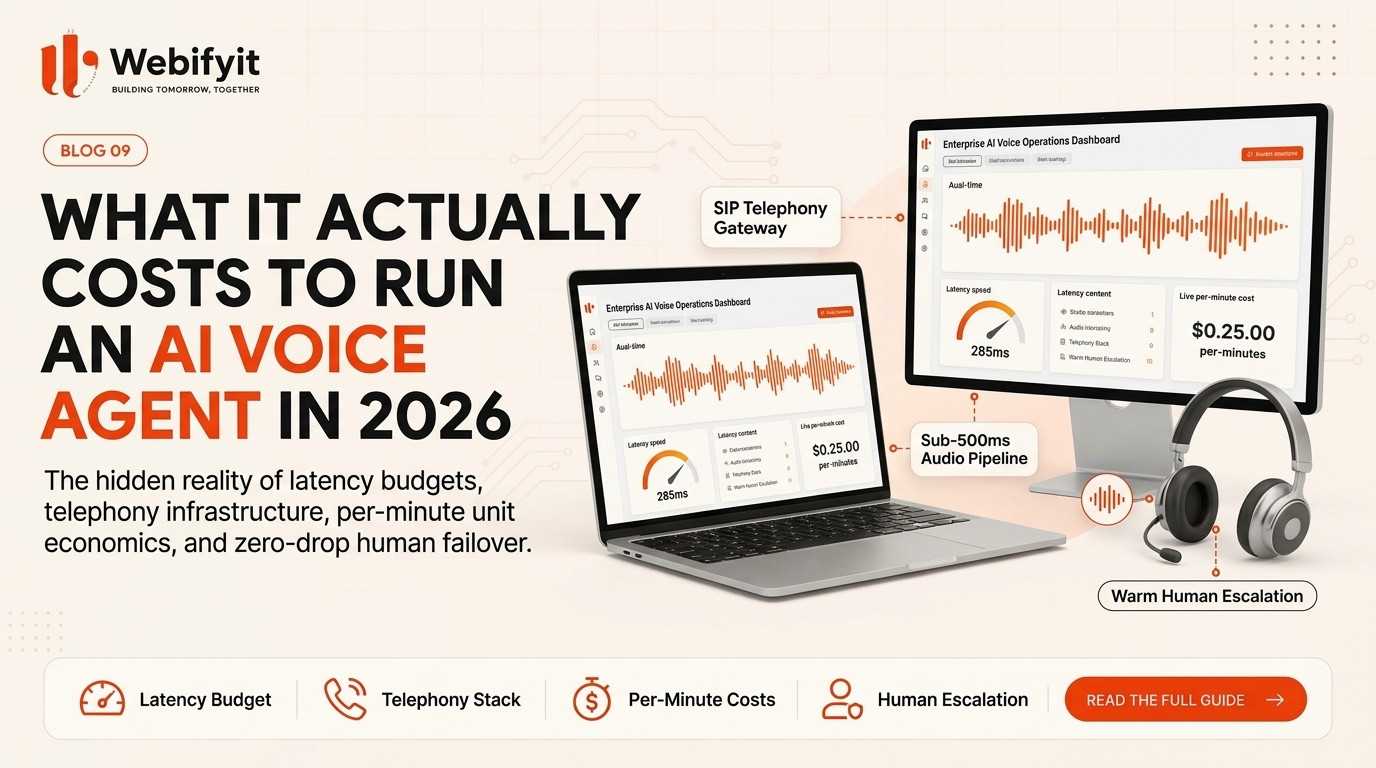
What It Actually Costs to Run an AI Voice Agent in 2026: The Hidden Reality of Latency, Telephony, and Human Failover
If you have seen an AI voice agent demo recently, you have likely heard the pitch:
"Replace your expensive call center. For two cents a minute, deploy a conversational voice agent that never sleeps, never takes a coffee break, and sounds exactly like a real human being."
It sounds irresistible.
A founder or customer experience director opens an online playground, speaks into their laptop microphone, and hears a remarkably natural AI voice respond within a few seconds.
They run the back-of-the-napkin math: three human support agents cost $12,000 per month; an AI voice bot handling 10,000 minutes might theoretically cost a few hundred dollars.
Then the business attempts to deploy this bot to live customer phone calls.
Within the first week, reality sets in:
- The actual monthly bill arrives, and instead of two cents a minute, the blended cost is between fourteen and twenty-eight cents per minute.
- Callers talk over the bot because the system takes 1.2 seconds to process each sentence, creating awkward pauses where both parties interrupt each other simultaneously.
- A customer with an accent or background traffic noise gets misunderstood three times in a row, the bot enters an endless repetition loop, and there is no graceful way to transfer the furious caller to a human agent.
- Telephony dead-air and carrier connection drops quietly burn billable minutes while customer satisfaction scores plummet.
This is the difference between a voice demo running in a web browser and an enterprise voice agent handling real-world telephone traffic.
In 2026, AI voice is no longer an experimental novelty. It is a production discipline governed by strict latency budgets, multi-vendor telephony economics, and robust failover engineering.
In this guide, we break down what running an AI voice agent actually costs, where the latency bottlenecks hide, and how serious engineering teams build voice systems that deliver genuine business value.
The 4-Layer Voice Stack: Why Cheap Demos Are Misleading
When a sales representative quotes an ultra-cheap per-minute rate, they are almost always quoting the cost of a single component—usually the raw language model inference—while omitting the rest of the operational stack.
A production voice agent is not a single software program. It is an orchestration of four independent real-time layers, each charging its own metered fees.
Layer 1: Telephony and Carrier Infrastructure
Before an AI can process a single word, audio must travel from the caller's mobile device across cellular towers and public switched telephone networks (PSTN) into your cloud servers.
This requires Session Initiation Protocol (SIP) trunking, incoming direct inward dialing (DID) phone numbers, and carrier connection routing.
Whether you route through providers like Twilio, Telnyx, or direct carrier interconnects, telephone carriers charge per-minute fees for inbound and outbound audio channels. Additionally, carrier fees often bill in sixty-second minimum increments, meaning a fourteen-second call is billed as a full minute.
Layer 2: Real-Time Streaming Speech-to-Text (STT)
Once audio reaches your server, incoming sound waves must be transcribed into text instantaneously.
Batch transcription APIs designed for recorded podcasts are useless here. The system requires ultra-fast streaming transcription engines that output partial word tokens with under 100 milliseconds of latency.
Streaming speech recognition services charge by the minute of active audio, and prices increase when enabling multi-language detection, profanity filtering, or custom acoustic models.
Layer 3: Language Model Reasoning and Tool Execution
The transcribed text is routed to a language model to decide the appropriate response.
Unlike traditional text chatbots where a user can wait two seconds for a paragraph to appear, a voice conversational agent requires immediate first-token responses.
Costs here depend on model size, system prompt length, and tool calls. Every time the voice agent checks your CRM database or looks up order status, additional tokens are consumed, driving up the reasoning cost for that turn of conversation.
Layer 4: Neural Text-to-Speech (TTS) Synthesis
Once the language model generates an answer, the text must be synthesized into realistic, emotive human speech.
Modern neural voices provide lifelike breathing, cadence, and prosody, but high-fidelity neural streaming audio is computationally demanding. Most state-of-the-art voice providers charge based on the total character count generated rather than elapsed minutes.
If your agent speaks verbose, lengthy explanations, your synthesis costs escalate rapidly.
The Real Per-Minute Economics: A Clear Breakdown
When you aggregate all four layers, what does one minute of live conversation actually cost in 2026?
Here is a realistic comparison between a custom-engineered modular pipeline and an all-in-one managed platform:
| Stack Component | Self-Hosted / Modular Pipeline | Managed All-in-One Platform |
|---|---|---|
| Telephony (SIP / Carrier Trunking) | $0.015 to $0.030 per min | Included in blended rate |
| Streaming Speech-to-Text (STT) | $0.006 to $0.015 per min | Included in blended rate |
| LLM Reasoning (First-Token Optimized) | $0.010 to $0.040 per min | Included in blended rate |
| Neural Text-to-Speech (TTS Synthesis) | $0.035 to $0.075 per min | Included in blended rate |
| WebRTC Cloud Orchestration Infrastructure | $0.010 to $0.020 per min | Included in blended rate |
| Total Blended Cost Per Active Minute | $0.076 to $0.180 per min | $0.200 to $0.450 per min |
The Hidden Variable: The Cost Per Resolved Call
Looking only at cost per minute is a dangerous trap.
The real operational metric is Cost Per Resolved Resolution.
Consider this scenario:
- Agent A (Poorly Architected): Costs $0.10 per minute. Because it has awkward latency and poor conversational flow, it takes seven minutes of repetitive clarification to resolve a scheduling inquiry. Total cost: $0.70.
- Agent B (Engineered with Fast Tool Access): Costs $0.16 per minute. Because it has sub-400ms latency and immediate database access, it resolves the caller's request in one minute and thirty seconds. Total cost: $0.24.
Agent B has a higher per-minute rate, yet costs nearly one-third of Agent A per resolved customer interaction, while delivering a dramatically superior customer experience.
The Sub-500ms Latency Budget: Why Milliseconds Break Conversational Trust
In face-to-face human conversation, the typical gap between one person stopping speaking and the other beginning to respond is between 200 and 300 milliseconds.
When a pause stretches beyond 600 milliseconds, human psychology interprets the delay as hesitation, confusion, or disconnection.
When latency climbs past 900 milliseconds, disaster occurs: the human assumes the machine did not hear them and starts speaking again, just as the AI begins generating audio. This causes an interruption collision where both sides speak over one another.
To build a voice agent that feels natural, you must enforce a strict Latency Budget where every layer operates under strict time constraints:
### The 2026 Production Latency Budget (Target: Sub-450ms Total)

1. Network & Telephony Transport (Jitter Buffer): 30ms – 60ms
   - Ingesting raw audio packets over WebRTC or SIP without packet loss.

2. Streaming Speech-to-Text Endpointing: 70ms – 120ms
   - Detecting that the user has finished their thought and producing finalized text.

3. LLM Time to First Token (TTFT): 100ms – 200ms
   - Selecting high-speed inference engines and concise system prompts to begin streaming tokens.

4. Neural TTS Time to First Chunk: 50ms – 90ms
   - Synthesizing the first audio chunk from the initial words before the full sentence finishes generating.

5. Audio Playback Buffer: 20ms – 40ms
   - Returning the audio stream to the caller's telephone receiver smoothly.
If any single component in your pipeline lags, the entire illusion of natural conversation shatters.
Achieving this speed requires moving completely away from traditional request-response architectures to continuous bidirectional streaming over WebRTC.
Architecture Choice: Modular Pipelines vs. Native Speech-to-Speech
In 2026, engineering teams face a fundamental architectural choice when building voice agents:
Approach 1: Modular Cascaded Pipeline (STT to LLM to TTS)
This is the current enterprise workhorse.
In this architecture, each stage is handled by a specialized engine: audio goes to a streaming transcription service, text goes to an LLM, and output text streams into a voice synthesizer.
The Advantages:
- Total Control: You can inspect and modify the transcript before sending it to the reasoning model.
- Vendor Independence: You can swap models at will. If a faster transcription model launches tomorrow, you switch it without altering your business logic.
- Deterministic Business Rules: You can intercept the conversation with deterministic guardrails, compliance checks, and privacy masking.
The Challenges:
- Latency Stacking: You must orchestrate three independent services and optimize each one aggressively.
- Loss of Tone Nuance: Text transcription strips away emotional nuance such as sarcasm, panic, or whispering before the LLM sees it.
Approach 2: Native Speech-to-Speech (Audio In, Audio Out)
Native multimodal models ingest raw audio directly and synthesize conversational audio out of the same neural network.
The Advantages:
- Human-Like Prosody: The model hears laughter, pauses, and voice inflections directly, responding with appropriate emotion and breathing.
- Lower Latency Potential: Bypasses intermediate text conversions.
The Challenges:
- Black-Box Governance: It is significantly harder to enforce deterministic guardrails or prevent hallucinations in raw audio.
- Vendor Lock-In: You are tightly married to a single proprietary foundation model provider.
- Compliance Complications: Generating compliance audit logs requires secondary transcription passes, increasing overall cost.
For enterprise applications where compliance, database accuracy, and predictable workflows are non-negotiable, the modular pipeline remains the preferred production choice.
The Zero-Drop Rule: Designing Deterministic Human Warm Transfer
Nothing destroys customer trust faster than an automated system that traps a caller in an unhelpful loop.
The mark of an enterprise-grade AI voice system is not that it answers every single question; it is that it knows exactly when and how to escalate to a human agent.
A production voice architecture requires three failover mechanisms:
1. Acoustic and Confidence Triggers
If background noise is high, or if transcription confidence scores drop below eighty percent for two consecutive conversational turns, the system should not guess. It should proactively ask once for clarification, and if still ambiguous, trigger escalation.
2. Emotional Sentiment Detection
When a caller uses frustrated language or expresses urgency, the agent should immediately acknowledge the situation calmly and transition to the escalation queue rather than reciting defensive policy statements.
3. The Contextual Handshake (Warm Transfer)
In traditional call centers, being transferred means repeating your account number, issue, and history all over again to a human representative.
In a modern AI system, the voice agent executes a warm SIP transfer:
- The audio call is bridged to the human agent's phone or browser workstation.
- Simultaneously, a structured payload is pushed to the agent's CRM screen.
- The human agent sees the caller's verified identity, a three-sentence summary of the problem, and a full live transcript of what the AI and customer discussed.
The human operator answers the line already knowing the issue: "Hello Sarah, I see you are inquiring about the invoice discrepancy on order 402. Let me resolve that for you right now."
This turns an automated interaction into a high-satisfaction customer service experience.
Practical Failure Modes Most Teams Overlook
Before launching a voice agent into production, ensure your engineering team has addressed these four operational blind spots:
1. Mid-Sentence Barge-in and Interruptibility
In real life, people do not wait for you to finish a long sentence before asking a question. If an AI voice agent cannot be interrupted immediately when the caller speaks, callers feel frustrated. Implementing real-time acoustic echo cancellation and instant audio buffer interruption is essential.
2. Telephony Dead Air Billing
When a customer puts their phone on hold or walks away, cellular lines remain open. Without sensible silence detection algorithms, your system will remain connected to an empty line, burning through your API credits indefinitely.
3. Number Formatting and Acronyms
Language models frequently hallucinate when reading telephone numbers, dates, or technical codes aloud. Text normalization layers must enforce that tracking numbers and currency figures are pronounced clearly rather than read as giant mathematical sums.
4. Concurrency Spikes
Unlike web servers that scale elastically, telephony carriers enforce hard limits on concurrent voice channels. If your marketing campaign triggers two hundred calls at once, excess calls receive busy signals unless your SIP infrastructure is engineered for queue bursting and overflow.
Frequently Asked Questions
How much does an AI voice agent typically cost to deploy for a mid-sized business?
A complete production deployment—including telephony integration, custom business logic, CRM database synchronization, and human escalation workflows—typically involves a one-time engineering setup investment, followed by ongoing infrastructure costs of $0.10 to $0.20 per active call minute.
Can AI voice agents handle different regional accents and languages?
Yes, modern acoustic transcription models handle regional accents with high accuracy, provided audio is processed with proper noise suppression. For multilingual applications, systems can dynamically switch language and voice models mid-conversation.
Why shouldn't we just use an off-the-shelf no-code voice bot builder?
No-code tools are excellent for simple appointment booking or basic FAQs. However, when you need deep two-way integration with proprietary databases, custom security policies, HIPAA or GDPR compliance, and real-time human desk transfers, rigid no-code platforms quickly become limiting bottlenecks.
What happens if our cloud server experiences a momentary outage during a call?
Production architectures include redundant carrier failover rules. If an AI server instance disconnects, the carrier SIP trunk automatically falls back to an alternate data center or routes directly to your human backup phone line, preventing dropped calls.
The Bottom Line
AI voice agents have moved beyond the realm of parlor tricks.
When engineered correctly, they eliminate hold times, resolve routine inquiries instantly, and free human staff to focus on high-touch, complex customer relationships.
The mistake is treating voice AI as a plugin rather than an engineering discipline.
It is not just about choosing a voice that sounds pleasant. It is about architecting low-latency audio pipelines, managing per-minute unit costs, and ensuring that every customer conversation is backed by dependable business logic and seamless human support.
Planning to deploy voice AI across your business or agency client workflows?
Schedule a Technical Architecture Consultation with Webifyit
Published by the Webifyit Engineering Team | Webifyit