
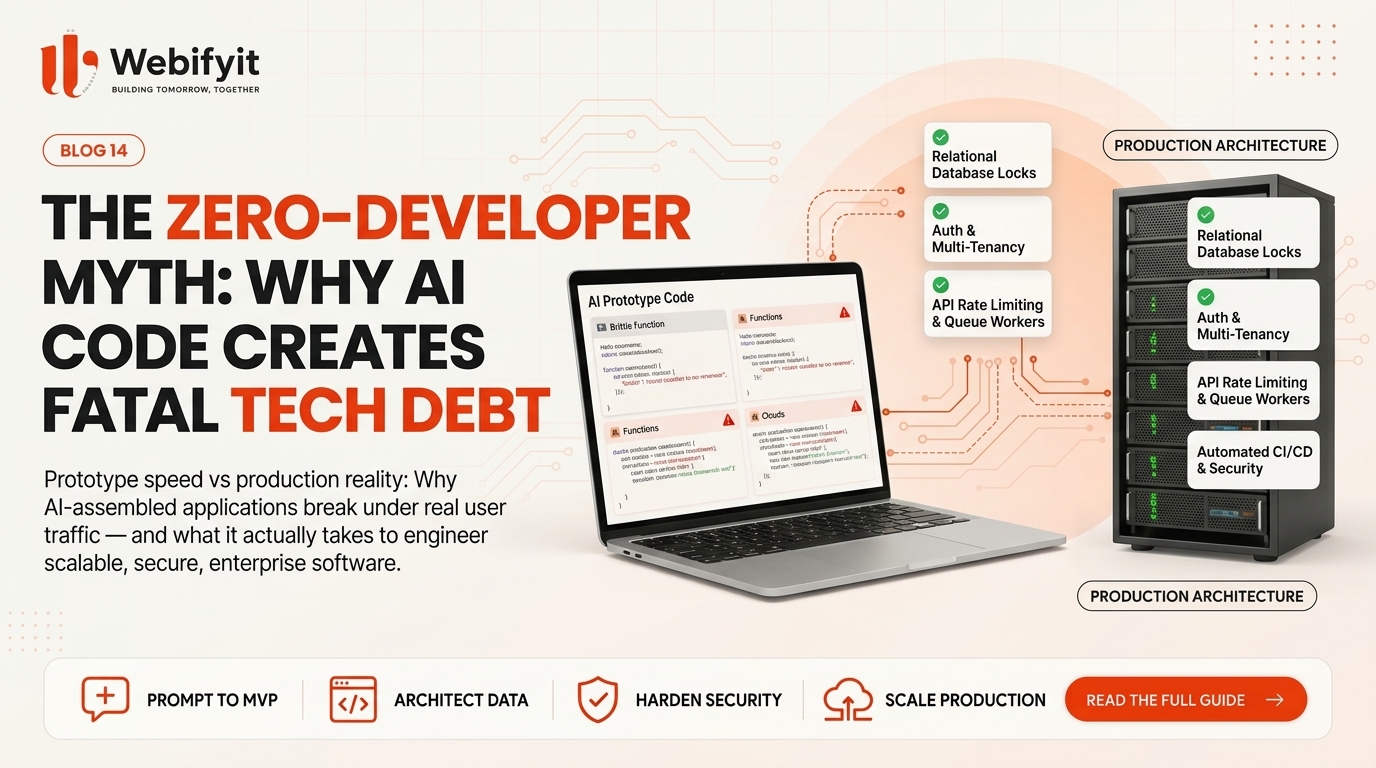
The Zero-Developer Myth: Why AI-Generated Codebases Create Fatal Technical Debt (and Why Systems Architecture Matters More in 2026)
Over the past two years, tech media and venture capital marketing promoted a seductive fantasy: software engineering is obsolete, anyone can build production-ready applications with conversational prompts, and professional developers are unnecessary overhead.
Non-technical founders, marketing agencies, and corporate teams opened modern AI code editors and built working prototypes in forty-eight hours.
Buttons clicked. Screens rendered. Stripe checkout forms processed test payments.
On the surface, the promise appeared fulfilled.
Then came launch day.
When forty real customers logged in simultaneously, the application ground to a halt. Database tables duplicated records because two users clicked a button at the same instant. A customer received someone else's private invoice because authentication tokens had no tenant isolation. An automated webhook failed quietly, freezing new user activations without generating an error log.
When the founder pasted the error messages back into the AI assistant, the model suggested a patch. That patch resolved the crash on page one, but severed the inventory calculation on page four.
Three weeks and seventy prompts later, the codebase became an impenetrable tangle of contradictory logic, unindexed database tables, and unmaintained external libraries.
The project had hit the AI code wall.
AI generates code quickly, but code generation is only a fraction of software engineering. Building software that stays running, protects customer data, and scales under financial pressure requires systems architecture, data modeling, and operational accountability.
Here is what happens when teams confuse prototype speed with production engineering, and how disciplined teams build durable systems in 2026.
The Difference Between Code Generation and Systems Engineering
To understand why AI-assembled software breaks, consider how large language models produce code.
A language model predicts token sequences based on pattern matching across millions of public GitHub repositories. When you ask it to build a user registration form, it pulls patterns from typical tutorials and basic examples.
Tutorial code is written for pedagogical simplicity. It intentionally strips out edge-case handling, database transactions, connection pooling, and defensive authentication to make the demonstration easy to read.
When an AI model produces your backend, it delivers tutorial-grade scaffolding. It produces something that looks correct in isolation, but lacks systemic cohesion.
True software engineering focuses on three foundational layers that token prediction cannot automate:
- State Coherence Across Systems: How changes in one module (such as canceling a subscription) propagate through billing, email queues, database records, and third-party webhooks without race conditions.
- Defensive Data Constraints: How database schemas prevent bad, corrupted, or conflicting data from ever reaching disk storage.
- Failure Recovery and Idempotency: What happens when an external payment API times out after taking a customer's money but before returning a confirmation receipt.
Writing the syntax for an API endpoint takes ten minutes. Designing that endpoint so it never drops money or locks database tables takes years of architectural discipline.
The Five Fatal Flaws of AI-Generated Codebases
Auditing dozens of AI-built codebases reveals the exact same systemic failures repeatedly. These are not minor bugs; they are architectural design flaws that require extensive refactoring.
1. Missing Database Transactions and Silent Record Corruption
When a customer completes a purchase, several database actions must succeed together:
- The customer's account balance decreases.
- The merchant's payout ledger increases.
- The item inventory decreases by one unit.
- An order confirmation record is created.
In professional software engineering, these operations run inside an atomic database transaction. If the inventory update fails because the item went out of stock a millisecond prior, the entire transaction rolls back cleanly. No money moves, and no broken records remain.
AI code generators almost never wrap multi-step operations in database transaction blocks unless explicitly instructed with precise syntax. Instead, they write sequential database calls.
If step one succeeds and step three fails, your database enters a corrupted state: the customer was charged, but the order record never saved. Multiply this across hundreds of daily users, and your team spends dozens of hours manually reconciling broken accounting records.
2. The Compounding Patch Trap
When human engineers write software, they hold a mental map of global dependencies. They know that altering a user permission flag in the authentication service impacts the reporting dashboard and the export scheduler.
Language models evaluate local context windows. When you report a bug in an AI-generated app, the assistant examines only the file you provide and writes a targeted fix for that specific symptom.
Because the model does not verify downstream consequences across your entire codebase, that localized fix frequently introduces subtle regressions in unrelated files.
This creates the compounding patch trap:
- Day 1: You fix user login.
- Day 2: The login fix breaks password resets.
- Day 3: The password reset fix breaks team invites.
- Day 4: The team invite fix breaks permission tiers.
Within two months, the codebase contains multiple competing state management patterns, duplicated API handlers, and thousands of lines of dead code that nobody understands or dares to touch.
3. Missing Indexing and the Performance Cliff
AI tools rarely analyze database query execution plans. They generate plain SQL queries that work instantaneously during development when the database contains twelve test rows.
When an application launches and reaches 50,000 records, unindexed queries force the database to perform full table scans on every single request.
A dashboard that loaded in 120 milliseconds during testing suddenly takes nine seconds to respond. Server memory spikes to 100 percent, database connections saturate, and the application crashes. Adding more server memory does not resolve the bottleneck; the underlying data model lacks indexes and relational keys.
4. Vulnerable Authentication and Incomplete Tenant Isolation
Security in multi-tenant SaaS applications requires strict boundary enforcement. User A must never access records belonging to User B.
AI models frequently implement superficial authorization. They verify that a user is logged in, but forget to verify whether that user owns the specific resource ID requested in the URL parameter.
An attacker can change the customer identifier in a request header from 1042 to 1043 and immediately view a competitor's confidential data. These horizontal privilege escalation vulnerabilities routinely pass unnoticed in manual testing because founders only test the application with their own administrative credentials.
5. Runaway Infrastructure Costs
AI generators default to heavy, bloated architectures. They recommend expensive managed cloud services, complex serverless functions, and unoptimized polling loops because those patterns appear frequently in marketing tutorials.
We regularly encounter early-stage startups spending $1,200 per month on cloud infrastructure for an application serving fewer than two hundred active users. That identical workload, properly engineered with efficient connection pooling, server-side caching, and lean database design, runs comfortably on a $40 dedicated virtual instance.
Comparison: AI-Generated Prototype vs. Production Engineering
| Engineering Pillar | AI-Generated Prototype | Production-Grade Engineering |
|---|---|---|
| Primary Metric | Speed of visual completion | System resilience, uptime, and maintainability |
| Database Integrity | Sequential writes, missing transactions, zero schema constraints | ACID transactions, strict relational foreign keys, verified indexes |
| State Management | Fragmented across client components, desynchronized states | Single source of truth with predictable unidirectional data flow |
| Concurrency | Tested for one user on localhost; breaks under concurrent writes | Connection pooling, optimistic locking, asynchronous queue workers |
| Security Posture | Default permissive routes, client-side permission checks | Defense-in-depth, server-enforced tenant isolation, sanitized inputs |
| Error Handling | Generic try-catch blocks that swallow errors silently | Structured logging, observability pipelines, graceful degradation |
| Maintenance Cost | Exponentially increases with each new prompt and patch | Predictable and modular; features add without breaking existing flows |
When Does AI Coding Make Sense (and Where to Draw the Line)?
Pointing out the limitations of AI coding does not mean teams should abandon modern developer tools. AI assistants are valuable utilities when placed in the hands of experienced engineers who understand system design.
Where AI Accelerates Engineering:
- Boilerplate Creation: Writing repetitive data transfer objects, standard form inputs, and basic schema definitions.
- Syntax Translation: Converting an established data transformation algorithm from Python to TypeScript.
- Test Data Generation: Creating realistic mock datasets to test edge-case inputs.
- Documentation Summaries: Drafting initial API references from established endpoints.
Where AI Fails Catastrophically:
- Domain Modeling: Determining how business concepts (contracts, seats, billing periods) map to relational database tables.
- Concurrency Control: Preventing race conditions when multiple users edit shared operational resources simultaneously.
- Security Boundaries: Designing cryptographic credential storage and role-based access control.
- Performance Tuning: Diagnosing database deadlocks, memory leaks, and network socket exhaustion.
If you do not know how a database manages locks, an AI cannot protect you from deadlocks. If you do not know how webhooks guarantee delivery, an AI cannot build you a reliable payment integration.
The Engineering Triage: How to Rescue a Brittle AI Prototype
If your team built an MVP using AI tools and is now experiencing production crashes, erratic bugs, or scaling bottlenecks, do not discard your domain knowledge. Follow this four-phase stabilization plan to transition your prototype into reliable software:
Phase 1: Lock Down the Data Schema
Stop adding new frontend features immediately. Your database is the foundation of your company; if the database is corrupted, the application cannot be saved.
- Audit all database tables to ensure primary keys, foreign key constraints, and unique indexes exist.
- Add database-level validation to prevent null values in critical financial and identity fields.
- Wrap all multi-step write operations into atomic transactions.
Phase 2: Enforce Server-Side Authorization
Assume every client-side request is potentially malicious or misconfigured.
- Remove all permission checks that rely solely on frontend state.
- Verify tenant ownership on every single API route using server-side session data.
- Implement rate limiting on sensitive authentication and payment endpoints to prevent brute-force attacks.
Phase 3: Decouple Heavy Operations with Background Workers
AI prototypes frequently execute heavy tasks (sending emails, generating PDF reports, syncing third-party APIs) directly inside the HTTP request loop.
If the external email service takes four seconds to respond, your user waits four seconds staring at a frozen screen. If the connection drops, the entire operation fails.
Move all non-immediate tasks to an asynchronous background worker queue with automatic retry logic and dead-letter queues. This ensures your user interface responds in under 150 milliseconds regardless of external API delays.
Phase 4: Establish Automated Regression Tests
Before writing another line of code, establish automated integration tests covering the three most critical user journeys: account creation, core workflow execution, and payment processing.
Automated tests act as permanent guardrails. When an engineer or an AI assistant modifies code in the future, the test suite immediately flags broken dependencies before they reach paying customers.
Frequently Asked Questions
What is vibe coding?
Vibe coding refers to writing software entirely through conversational natural language prompts to AI tools without inspecting the underlying source code or understanding the software architecture. While effective for rapid prototyping and mockups, it produces fragile codebases prone to data corruption and security failures in production.
Why does my AI-built app crash when real users sign up?
Prototypes built with AI are typically tested by a single person performing one action at a time. Real production environments introduce concurrent users making simultaneous requests. Without connection pooling, database transaction locks, and proper memory management, simultaneous operations trigger race conditions and crash the server.
Can non-technical founders use AI to build a viable SaaS?
Non-technical founders can successfully use AI to build interactive proof-of-concept prototypes to validate customer interest and secure early feedback. However, converting that prototype into a secure, commercially viable product requires professional systems engineering to handle multi-tenancy, data integrity, and operational scale.
Is it cheaper to fix an AI-generated codebase or rebuild it from scratch?
It depends on the state of the database schema. If the core database structure is reasonably coherent, experienced engineers can refactor the backend logic and secure the endpoints in two to three weeks. If the database lacks relational structure and contains corrupted records, rebuilding the backend on a clean architecture while preserving the frontend designs is usually faster and more cost-effective.
How does an engineering partner like Webifyit help with AI prototypes?
Webifyit conducts technical audits of existing prototypes, identifies security vulnerabilities, hardens database schemas, implements reliable background worker queues, and establishes scalable production architectures. We turn fragile ideas into dependable, enterprise-ready software.
The Bottom Line
Building software has never been faster, but engineering reliable systems has never required more vigilance.
AI code generators are powerful power tools. In the hands of a skilled architect, they accelerate delivery. In the hands of someone who cannot read the blueprint, they build houses without foundations.
Do not let initial prototype speed fool you into ignoring operational reality. Prioritize data integrity, protect customer security, and invest in systems architecture before your users force you to.
Have an AI prototype that is struggling to scale, or need dependable software engineered right the first time?
Webifyit partners with founders, businesses, and digital agencies to design, build, and harden production-grade web applications, custom APIs, and intelligent software workflows.
Explore Software Engineering with Webifyit
Published by Atharv K. | Webifyit