How Agencies Can Sell Custom Software & AI Without Hiring Developers in 2026
If you run a digital, creative, or performance agency in 2026, you have probably experienced a conversation like this:
A client comes to you after a successful campaign or rebrand and says:
"We love what you did with our branding and marketing. But now we have a bigger challenge. Our team is drowning in spreadsheets, our CRM doesn't talk to our logistics system, and we want an automated WhatsApp workflow connected to our inventory. Can you build this custom portal and AI workflow for us?"
It sounds like the perfect client opportunity.
And financially, it can be.
But it can also become an operational nightmare.
Your agency may be excellent at creative strategy, branding, performance marketing, UI/UX, content, or conversion optimisation. But suddenly the client wants database architecture, APIs, authentication, cloud infrastructure, AI agents, integrations, testing, security, and ongoing technical support.
That is a very different business.
So what do you do?
Say no and lose a valuable client opportunity?
Hire an engineering team and take on a huge fixed cost?
Or hire random freelancers and hope everything works?
There is another option.
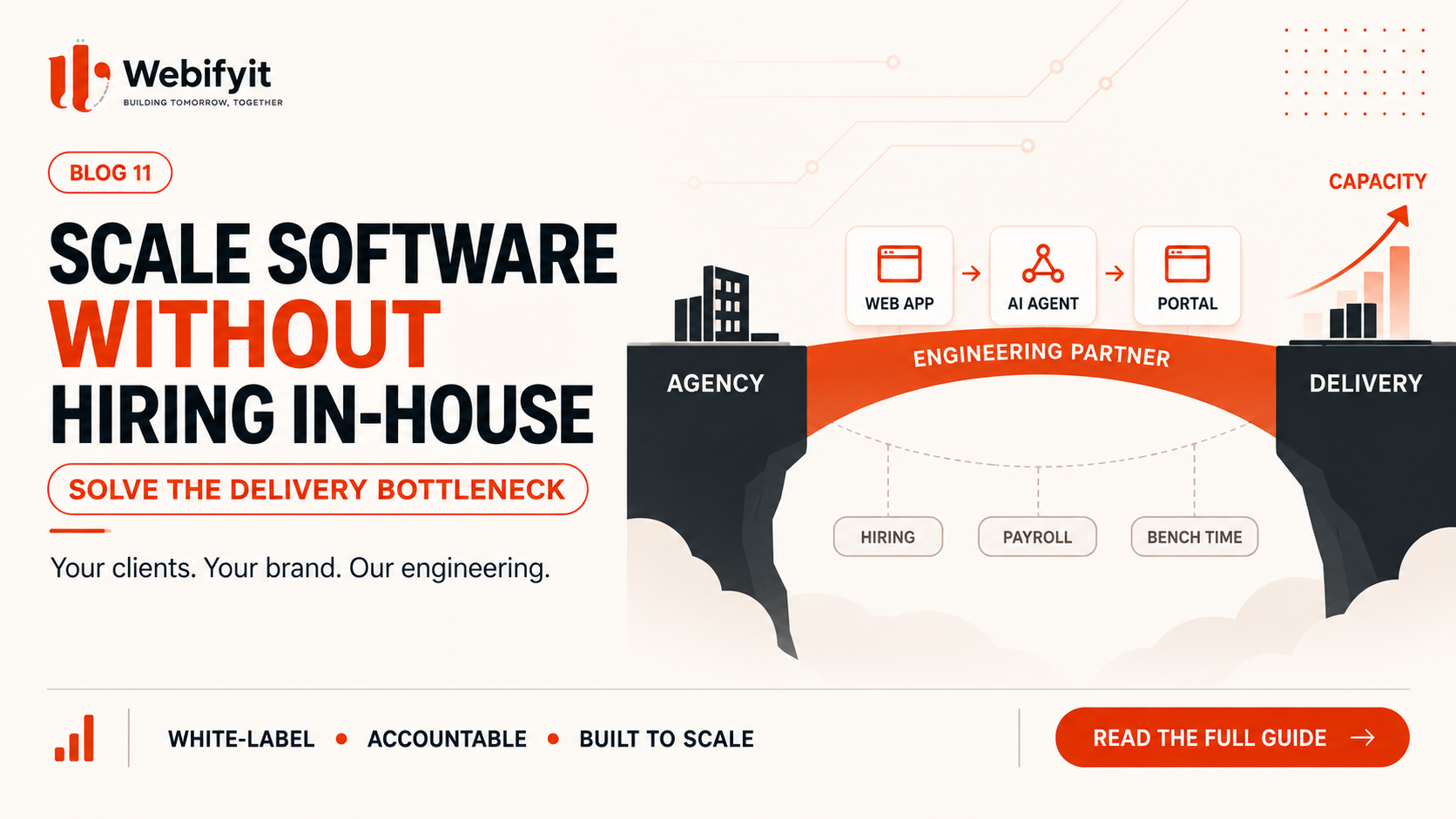
Build an accountable engineering partnership behind your agency.
Your agency owns the client relationship, strategy, design and commercial side.
The engineering partner handles the technical execution.
This allows agencies to expand into high-ticket software and AI projects without immediately building an engineering department from scratch.
Why This Matters in 2026
For years, digital agencies could grow by selling websites, SEO, paid advertising, landing pages, email campaigns and social media management.
Those services still matter.
But the higher-value opportunities are increasingly moving beyond marketing.
Clients are asking agencies for:
- Customer and vendor portals
- Internal business dashboards
- Custom CRM systems
- AI-powered support
- WhatsApp automation
- AI lead qualification
- Inventory systems
- Operational software
- Custom SaaS platforms
- Internal workflow automation
The problem is that these projects require a very different technical capability.
A marketing website can be relatively straightforward to maintain.
A business application is different.
It may contain customer information, payments, user permissions, databases, APIs and workflows that directly affect how the company operates.
That creates a delivery gap.
The agency sees the opportunity.
The agency has the client.
The agency understands the business.
But the agency may not have the engineering capacity to safely deliver the project.
That gap is the agency delivery bottleneck.
The Shift From Websites to Business Systems
A decade ago, a client might ask an agency for a new website.
Today, the same client may ask for something much more involved.
They may want:
A website that connects to their CRM.
A dashboard that pulls information from their internal systems.
A customer portal with login and role-based access.
A WhatsApp workflow that checks inventory.
An AI agent that qualifies leads.
An internal system that replaces spreadsheets.
The difference is significant.
You're no longer just delivering a website.
You're delivering part of the client's operational infrastructure.
That means the project needs careful attention to security, data, integrations, reliability, testing and long-term maintenance.
And this is exactly where many agencies get into trouble.
Three Common Ways Agencies Try to Solve the Problem
When agencies realise their clients want software and AI, they usually take one of three approaches.
1. Hire an In-House Engineering Team
This sounds like the safest option.
Hire a senior developer.
Then another developer.
Maybe someone for frontend work.
Maybe QA.
Maybe someone who understands AI.
The problem is fixed overhead.
Your agency's marketing revenue might fluctuate from month to month.
Engineering salaries don't.
You might have three large software projects in one quarter and very little engineering work in the next one.
But the payroll continues.
There is another issue.
Running an engineering team requires engineering leadership.
Someone needs to review architecture.
Someone needs to evaluate code quality.
Someone needs to manage deployments.
Someone needs to understand security.
Someone needs to make sure technical decisions aren't creating problems six months later.
For a non-technical agency founder, that can become a second management problem.
2. Hire Freelancers for Every Project
The opposite approach is to stay lean and bring in freelancers whenever a project arrives.
The economics look attractive at first.
No permanent payroll.
No office cost.
No long-term commitment.
But the risk moves somewhere else.
You have to find the right developer repeatedly.
You have to understand whether their technical claims are accurate.
You have to manage the project.
You have to review the work.
You have to deal with availability.
And if something breaks shortly before the client presentation, your client isn't going to contact the freelancer.
They're going to contact you.
That is the important part.
The freelancer owns the task. Your agency owns the reputation.
3. Force the Client Into Existing SaaS
Another option is to recommend an existing SaaS product.
This is sometimes the right decision.
But it doesn't work for every business.
The client may have a workflow the software doesn't support.
There may be limitations around integrations.
There may be user or usage limits.
The interface may not fit the client's processes.
And eventually, the client may realise they are paying every month for software that still requires employees to work around its limitations.
For a simple requirement, SaaS is often perfect.
For a highly specific operational workflow, it may not be.
The Better Model: Front-of-House and Back-of-House
The model we believe makes the most sense for agencies is similar to hospitality.
There is a front-of-house team.
And there is a back-of-house team.
The agency remains responsible for the client-facing side.
That includes:
- Client relationships
- Strategy
- Discovery
- Creative direction
- UI/UX
- Project communication
- Commercial negotiations
- Billing
- Account management
The engineering partner handles the technical delivery.
That includes:
- Technical architecture
- Backend development
- Database design
- API integrations
- AI workflows
- Cloud infrastructure
- Testing
- Security
- Deployment
- Maintenance
The client still experiences one agency.
The agency simply has a stronger technical engine behind it.
Why This Model Works
The agency already has what an engineering company usually doesn't.
It has relationships.
It has clients.
It understands marketing.
It understands positioning.
It knows how to communicate with decision-makers.
It can identify business opportunities.
What it may not have is enough technical capacity.
An engineering partner fills that gap.
Instead of hiring five developers before the sales pipeline justifies them, the agency can access engineering capacity when the projects actually arrive.
That changes the economics.
You are no longer carrying the full cost of an engineering department during quiet periods.
At the same time, you don't have to reject valuable software opportunities when clients ask for them.
What the Agency Should Own
The agency should remain the primary owner of the client relationship.
The client should trust your agency.
Your agency should lead discovery and understand what the client actually needs.
You should control the commercial proposal.
You should own the project communication.
You should understand the business objectives.
You don't need to become a software engineer.
But you do need to understand the outcome the engineering team is building toward.
For example, if the client says:
"We need a custom portal."
Don't simply pass that sentence to the engineering partner.
Understand:
Who will use it?
What will they do?
What problem is the portal solving?
What information needs to be available?
What systems need to connect?
What happens after a user takes an action?
That discovery work remains extremely valuable.
What the Engineering Partner Should Own
The engineering partner turns the business requirements into a technical system.
That means deciding:
How should the system be structured?
What database is required?
Which APIs need to connect?
What should be automated?
What permissions should users have?
What happens when something fails?
How should the application be tested?
How should it be deployed?
How should it be maintained?
That is a specialist job.
And it is better handled by engineers who build these systems regularly.
Four High-Value Services Agencies Can Add
Once you have reliable engineering capacity, you can start offering much more valuable technical services.
1. Custom Client and Vendor Portals
Many businesses still manage customers and suppliers through spreadsheets, emails and fragmented systems.
A custom portal can centralise those workflows.
Customers might log in to see orders, documents or status updates.
Suppliers might submit information or upload files.
Internal employees get a dashboard to manage everything.
This creates a much deeper relationship between the agency and the client than a simple marketing website.
2. AI-Powered WhatsApp and Customer Support
WhatsApp is already a major business communication channel.
Businesses increasingly want more than automated replies.
They want systems that can understand a customer's request, retrieve information, and take action.
For example, an AI agent could answer product questions, check order status, qualify an enquiry, schedule an appointment or escalate an unusual request to a human.
The important part isn't simply the AI conversation.
It's the connection to the client's actual business systems.
3. Back-Office Automation
Think about everything employees do repeatedly.
Downloading spreadsheets.
Copying data.
Checking invoices.
Updating the CRM.
Matching information between systems.
Sending reminders.
Preparing reports.
These workflows are often strong candidates for automation.
A custom internal system can connect the different tools and reduce the amount of repetitive work employees have to perform.
4. Modernising Legacy Systems
Some established companies have old internal software that technically works but is difficult to use.
They may not want to replace everything.
They may simply want a modern interface.
An engineering partner can build a modern application around the existing infrastructure rather than forcing the company into a risky full migration.
This can be a valuable opportunity for agencies working with established businesses.
Don't Quote Software Projects Too Quickly
This is one of the biggest lessons agencies need to understand.
A client saying:
"We want an app."
does not tell you enough to provide an accurate price.
The same sentence could mean a simple internal tool or a complex business platform.
Before quoting, there should be a proper discovery process.
Understand the users.
Map the workflows.
Identify integrations.
Define the key features.
Clarify what is in scope.
Identify what isn't.
Then get the technical team involved.
This prevents one of the most common problems in software projects:
underquoting the complexity and discovering it halfway through development.
Start With a Focused First Version
You also don't need to build everything at once.
Suppose a client wants an entire sales platform.
Instead of building the entire system immediately, start with the most valuable workflow.
For example:
Lead arrives → AI qualifies the lead → CRM is updated → sales meeting is booked.
Prove that this works.
Then expand.
This gives the client visible progress while reducing technical and commercial risk.
Build in Clear Milestones
Software projects become much easier to manage when clients can see progress.
Rather than disappearing for three months and returning with a finished product, break development into milestones.
The first milestone might establish the foundation.
The next might deliver the core workflow.
The next might connect third-party systems.
The next might focus on testing and refinement.
The client gets regular visibility.
The agency gets better control over scope.
The engineering team gets clearer priorities.
Everyone benefits.
Don't Forget the Retainer
Software is not finished when it goes live.
There will be:
API changes.
Browser changes.
Security updates.
Bug fixes.
New feature requests.
Performance improvements.
Database maintenance.
AI model and cost optimisation.
That makes software a strong foundation for recurring revenue.
Instead of treating development as a one-time project, agencies can build ongoing technical retainers around maintenance, support and continuous improvement.
This can be especially valuable for agencies that already have strong client relationships.
How to Protect Your Agency
A good engineering partnership needs more than technical capability.
It needs commercial and operational rules.
Clear Intellectual Property Ownership
Your contracts should clearly define who owns the source code and deliverables.
The client shouldn't discover later that part of the system is locked to a third party.
Non-Solicitation and Non-Circumvention
Your engineering partner should not use your client relationship to compete with you.
The agency owns the relationship.
The engineering partner supports delivery.
That boundary needs to be clear from the beginning.
One Communication Structure
The client should not have five different developers messaging them independently.
Keep communication organised.
Your agency remains the primary client-facing team.
The engineering partner provides technical expertise through the agreed process.
This creates a much more professional experience.
The Economics Can Be Powerful
Let's say an agency has a strong pipeline of marketing and creative work but occasionally receives software opportunities worth tens of thousands of dollars.
Hiring a full engineering team just to support those projects can be difficult to justify.
An engineering partnership changes that equation.
You can take on the project.
Pay for the technical capacity you actually use.
Maintain your existing team structure.
And potentially create an entirely new recurring revenue stream.
The exact economics will depend on your pricing, delivery costs and project scope.
But the key idea is simple:
You don't need to own an entire engineering department to sell engineering services.
The Biggest Mistake Agencies Make
The mistake isn't partnering with engineers.
The mistake is partnering without accountability.
A cheap developer is easy to find.
A reliable engineering partner is much harder to find.
You need someone who understands that when something goes wrong, the agency is the one standing in front of the client.
That means engineering quality matters.
Documentation matters.
Testing matters.
Communication matters.
Security matters.
Deadlines matter.
And ownership matters.
The partnership needs to behave like an extension of your team, not like a random freelancer working in the background.
Where Webifyit Fits
This is exactly the gap Webifyit is built to address.
We work as a behind-the-scenes software and AI engineering partner for agencies that already have the client relationship but need deeper technical execution.
That can include:
- Custom web applications
- SaaS platforms
- AI agents
- WhatsApp automation
- Internal business tools
- Dashboards
- API integrations
- Mobile applications
- Ongoing engineering support
The agency brings the client, strategy and design.
We handle the engineering.
The goal is simple:
Your clients. Your brand. Our engineering.
Final Takeaway
Agencies don't necessarily need to become engineering companies.
They need to become better at recognising engineering opportunities.
When a marketing client asks for a portal, an automation system or an AI workflow, the answer doesn't have to be:
"We don't do that."
And it shouldn't automatically be:
"Let's hire five developers."
There is a middle ground.
Build the client relationship inside the agency.
Keep strategy and creative control in-house.
Bring in accountable engineering capacity when the project requires it.
Start with a focused scope.
Deliver in milestones.
Build the long-term support relationship.
That allows an agency to move further up the value chain without taking on the full cost and complexity of an engineering department.
And in 2026, that can be one of the most practical ways for agencies to turn existing client relationships into much larger technology opportunities.
Frequently Asked Questions
Can a marketing agency really sell custom software without having developers?
Yes. The agency still needs to understand the client's business problem and manage the relationship, while a reliable engineering partner handles the technical execution.
Should agencies completely avoid hiring developers?
Not necessarily. An in-house team can make sense once software demand becomes consistent enough to justify the fixed cost. The important thing is to hire when the pipeline supports it.
How does white-label engineering work?
The agency remains client-facing while the engineering partner works behind the scenes. The exact branding, communication and operating structure should be agreed upon between both parties.
What types of projects are best suited for an engineering partnership?
Custom portals, AI agents, SaaS platforms, internal dashboards, workflow automation, API integrations and legacy-system modernisation are all strong examples.
Should an agency offer software retainers?
For suitable projects, yes. Software requires ongoing maintenance, updates, security work and improvements, which can create a natural recurring service.
Action Checklist for Agency Founders
- Review your existing clients for software and automation opportunities.
- Identify clients still relying heavily on spreadsheets and manual workflows.
- Document the types of technical projects your clients are already requesting.
- Decide which services you could sell with external engineering capacity.
- Create a clear discovery and scoping process.
- Find an engineering partner that can work under your operating model.
- Package ongoing technical support into your proposals.
Have a client asking for software or AI that your agency can't currently deliver?
Schedule an Agency Partnership Consultation with Webifyit
Published by the Webifyit Engineering Team | Webifyit