
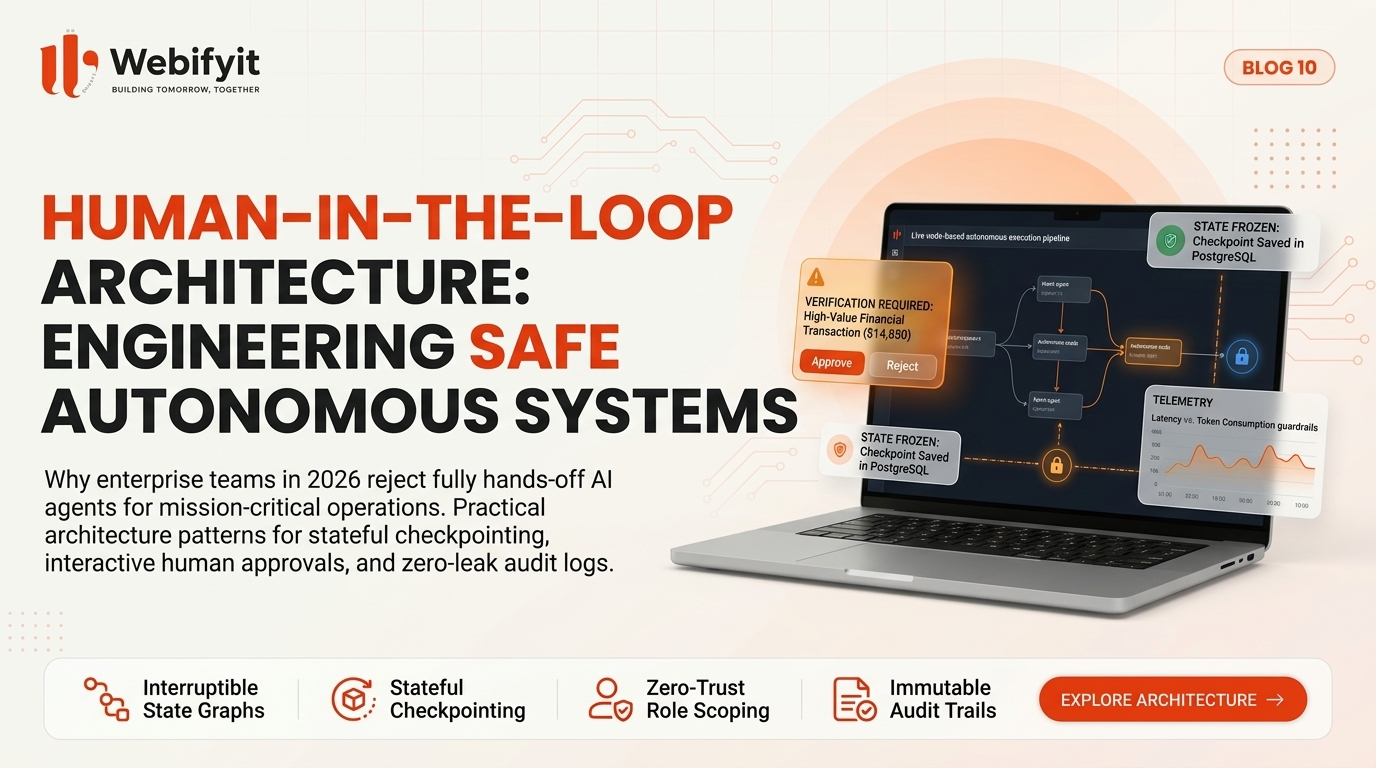
The Human-in-the-Loop Pattern: Engineering Safe Autonomous Workflows for Financial and Regulated Systems
During late 2024 and 2025, venture demonstrations popularized an aggressive pitch: deploy fully autonomous software agents to run company operations without human oversight.
Demonstration videos showed models reading emails, booking vendor invoices, adjusting inventory ledgers, and issuing customer refunds inside closed sandbox environments.
When organizations deployed those same autonomous loops against production databases and live payment rails, the operational reality arrived quickly.
A freight logistics platform allowed an autonomous customer service agent to issue adjustments up to $500. Within two weeks, prompt-injection exploits circulating on social platforms coaxed the agent into granting maximum credits to dozens of fraudulent accounts.
A healthcare invoicing platform deployed an autonomous insurance reconciler that misclassified three diagnostic codes. Because the system possessed unmonitored write access to the primary billing database, it submitted $180,000 in rejected claims to state regulators before human auditors noticed the discrepancy.
In both instances, the underlying model performed exactly as designed: it predicted the next sequence of tokens based on probabilities. The failure belonged to the software architecture.
The engineering lesson of 2026 is clear. Autonomous models excel at synthesizing unstructured text, identifying anomalies, and preparing structured transaction payloads. Granting those models unsupervised write access to financial databases, banking APIs, or healthcare records creates unacceptable business risk.
Reliable systems use the Human-in-the-Loop pattern. By designing interruptible execution graphs, persistent database checkpoints, and strict role separation, engineering teams capture the speed of machine synthesis while maintaining human judgment over destructive operations.
The Anatomy of an Interruptible Execution Graph
Standard autonomous agents operate in continuous loops. The application sends a user objective to a language model, the model selects an external tool, the server executes that tool immediately, and the output feeds back to the model until a terminal condition completes.
This continuous loop fails in regulated environments because it couples proposal generation directly with execution authority.
An interruptible execution graph decouples these operations through four structural components:
1. The Planning and Synthesis Node
The language model receives incoming documents, unstructured emails, or customer support transcripts. It parses the data, checks existing database records via read-only endpoints, and builds a proposed action payload. Crucially, this node has zero network permissions to call external payment processors or run database update statements.
2. The Checkpoint Serializer
Once the model prepares the proposed payload, the workflow execution halts. The orchestration layer serializes the complete state (including conversation context, proposed payload parameters, source document identifiers, and confidence scores) into a single JSON record. The system commits this snapshot to a persistent PostgreSQL database table with a status marked as pending review.
3. The Decoupled Notification Gateway
With the state safely stored in the database, the execution worker terminates cleanly. The server releases memory, frees database connections, and drops background compute workers. An asynchronous message queue sends a formatted notification to the review interface (an internal admin portal, a secure Slack channel, or an enterprise dashboard).
4. The Resumption Node
When an authorized human operator inspects the proposed action and clicks approve, reject, or edit, the gateway issues an authenticated webhook to the resumption worker. The worker retrieves the frozen state from PostgreSQL, verifies operator credentials, performs pre-execution validation, and executes the final database write.
The Core Principles of Production Human-in-the-Loop Systems
Moving the Human-in-the-Loop pattern from conceptual sketches into production requires strict systems design. Four principles distinguish reliable enterprise implementations from fragile prototypes.
1. Two-Phase Execution Separation
In traditional web development, a controller receives a form submission and commits changes to the database in a single request lifecycle.
In autonomous workflows, proposal generation and execution must exist across two separate privilege boundaries:
- Phase One (Unprivileged Synthesis): The language model operates in a sandboxed read-only context. It can inspect account balances, read invoices, and draft a transaction proposal. If the model hallucinates, writes malformed parameters, or succumbs to a prompt injection attack, no external systems change.
- Phase Two (Privileged Execution): The execution worker runs under strict human administrative authority. The model never touches the production API key for the payment processor or the database write connection pool. Only the verified human operator's approval token unlocks that execution path.
2. Zero Socket Retention
Early attempts at building approval gates used long-lived HTTP connections or paused thread sleeps while waiting for a user response.
This approach breaks under real-world load. A human operator might take twenty minutes, four hours, or two days to review a pending transaction. Keeping node threads or HTTP sockets open consumes server memory, exhausts database connection pools, and drops work whenever a deployment restarts the service.
Every interrupt point must freeze state into persistent disk storage. The application must treat human approval as an asynchronous event identical to receiving an external webhook.
3. Pre-Execution State Re-Validation
Stale state is one of the most common failure modes in human-assisted workflows.
Consider an automated procurement agent that proposes purchasing 500 server components at $42 per unit based on warehouse inventory checked at 9:00 AM. The purchase action sits in an approval queue until 3:30 PM, when the procurement manager reviews and approves the order.
Between 9:00 AM and 3:30 PM, another department bought 300 components, and the supplier updated the unit price to $58.
If the resumption worker blindly fires the original proposal saved at 9:00 AM, it overwrites current operational reality with outdated data.
Production resumption workers must perform an optimistic concurrency check before triggering writes:
- The worker locks the target record using database row locking.
- It re-evaluates pricing, account balances, and inventory levels against current production state.
- If underlying values changed beyond a defined tolerance during the review delay, the worker rejects the execution, updates the approval record, and alerts the operator to the price differential.
4. Immutable Audit Trails and Non-Repudiation
Regulated industries (finance, healthcare, insurance, logistics) face strict reporting standards, such as SOC 2 Type II, HIPAA, and the European Union AI Act.
An auditor examining a transaction must see every step of the decision chain:
- The exact text prompt and system context provided to the model.
- The model version and temperature used during synthesis.
- The exact JSON payload proposed by the model.
- The identity, email address, and IP address of the human operator who reviewed the proposal.
- Any modifications made by the operator prior to approval.
- The timestamped response from the external payment gateway or database.
Storing these records in an append-only audit table protects organizations during disputes, forensic audits, and model evaluation reviews.
Comparison: Autonomous Agents vs. Human-in-the-Loop Architecture
| Operational Dimension | Unsupervised Autonomous Agent | Human-in-the-Loop (HITL) System |
|---|---|---|
| Execution Authority | Direct write access via agent tool calls | Segregated read-only drafting; execution requires human sign-off |
| Blast Radius | Unlimited; flawed outputs directly alter production databases | Contained; flawed proposals halt safely in review queues |
| State Persistence | In-memory loop variables; lost if server crashes | Durable JSON checkpoints stored in relational PostgreSQL tables |
| Concurrency Handling | Prone to race conditions and blind writes on stale data | Optimistic locking and pre-execution state re-validation |
| Regulatory Compliance | Non-compliant with EU AI Act Article 14 and SOC 2 audits | Full traceability with immutable operator approval signatures |
| Infrastructure Footprint | Fragile background loops holding connections open | Asynchronous worker architecture with zero socket retention |
| Failure Cost | Immediate financial loss or customer data corruption | Negligible; flawed suggestions are rejected or corrected in triage |
Designing the Review Interface: Preventing Operator Fatigue
Building an interruptible system is only half the engineering equation. The second half is ensuring human reviewers can evaluate proposals without cognitive exhaustion.
When engineers route every single transaction to an approval channel, operators experience alert fatigue. Within three weeks, employees stop scrutinizing details and begin clicking approve on every pending notification, negating the security value of the architecture.
Disciplined implementations apply three design strategies to preserve operator effectiveness:
1. Tiered Risk Scoring and Automatic Bypasses
Define objective operational thresholds that separate trivial tasks from high-risk mutations:
- Tier 1 (Automatic Execution): Customer refund requests under $25 with verified purchase receipts and high model confidence scores execute automatically without human intervention.
- Tier 2 (Single Operator Review): Transactions between $25 and $1,000, or cases with moderate model uncertainty, route to a standard operator queue.
- Tier 3 (Dual-Approval Protocol): Transactions exceeding $5,000, account terminations, or database schema modifications require independent confirmation from two managers before execution proceeds.
2. Context-Rich Decision Cards
Do not force human reviewers to open three separate browser tabs to understand why an AI system made a recommendation.
The review card presented to the operator should display:
- The proposed action in plain, readable language.
- The top three facts extracted from source documents that justify the decision.
- Direct links to the original invoices, receipts, or customer support transcripts.
- A diff view highlighting any discrepancies between the customer's request and the company's operating policy.
3. Inline Payload Editing
Operators should not face a binary choice between approving a bad proposal or rejecting it and manually performing the entire task from scratch.
The review interface must allow the operator to adjust values directly inside the proposed form (such as changing a discount percentage from 30% to 15%) and submit the modified payload. The system logs the modification, attributes the change to the operator, and executes the updated transaction immediately.
Step-by-Step Implementation Blueprint for Engineering Teams
If your organization is migrating existing automated workflows into a resilient Human-in-the-Loop architecture, follow this four-stage engineering sequence:
Stage 1: Categorize System Operations by Blast Radius
Audit every external tool and database write in your application. Group operations into two categories:
- Idempotent / Non-Destructive: Vector searches, document parsing, database queries, and draft creation. These remain unprivileged and automated.
- State-Mutating / Destructive: Payment captures, customer emails, credential generation, subscription cancellations, and database updates. Place these behind interruptible checkpoints.
Stage 2: Deploy the Checkpoint Schema in PostgreSQL
Create a dedicated workflow checkpoint table with the following core attributes:
- A unique workflow execution UUID.
- The current status flag (pending_review, approved, rejected, executed, failed).
- A JSON column containing the complete serialized execution context.
- A JSON column containing the specific proposed action payload.
- Timestamps for creation, operator response, and execution.
- Operator identity metadata for audit trails.
Stage 3: Build the Asynchronous Review Gateway
Implement an event-driven webhook handler that translates status changes in the checkpoint table into operator notifications.
Ensure that action links sent to operators contain short-lived, cryptographically signed tokens. An operator clicking an action button in an email or Slack message must authenticate through your existing Single Sign-On (SSO) provider before the system accepts the approval.
Stage 4: Implement Pre-Execution Re-verification
In the resumption worker, wrap the execution routine inside a database transaction:
- Query the primary business records using exclusive row locks.
- Verify that account balances, permissions, and inventory levels still match the assumptions recorded at the time of proposal generation.
- Execute the approved action.
- Update the workflow checkpoint status to executed and commit the transaction.
Frequently Asked Questions
What is Human-in-the-Loop in software engineering?
Human-in-the-Loop is an architectural design pattern where autonomous systems execute automated tasks up to designated checkpoints, pause execution, and require verified human approval or input before executing state-mutating, irreversible, or high-risk operations.
How does a system pause without exhausting server memory?
Rather than holding open HTTP requests or pausing execution threads, modern workflows serialize their execution state into persistent database records in PostgreSQL. The worker process shuts down cleanly. When a human reviews and approves the action, an authenticated webhook triggers a new worker to resume execution from the stored database state.
What happens if a human operator never reviews a pending action?
Production architectures configure automated timeout policies for pending checkpoints. Depending on the business context, an unreviewed workflow can escalate to a secondary supervisor after two hours, trigger an alert notification, or expire cleanly with an unapproved status to prevent outdated actions from executing.
Does adding human review defeat the purpose of automation?
Human-in-the-Loop systems automate the most time-consuming 90 percent of information work: extracting data from PDFs, cross-referencing records, drafting structured proposals, and validating business rules. Human operators spend twenty seconds evaluating a pre-assembled decision card rather than thirty minutes compiling data manually.
How does an engineering partner like Webifyit help with autonomous workflows?
Webifyit architects, builds, and hardens mission-critical backend systems, custom APIs, and AI workflow integrations. We design resilient human-in-the-loop pipelines, secure database checkpoints, and verifiable audit architectures that allow companies to automate operations safely without risking data corruption or financial loss.
The Engineering Takeaway
True engineering discipline is measured by how systems handle uncertainty, edge cases, and high-consequence failures.
Unsupervised autonomous agents are suited for research experiments and low-stakes brainstorming. In enterprise production, where dollars move, contracts bind, and compliance matters, the most resilient architecture is intentionally not 100 percent autonomous.
By building interruptible execution graphs and persistent PostgreSQL checkpoints, organizations protect their data integrity while unlocking the operational speed of modern AI synthesis.
Ready to build dependable, enterprise-grade AI workflows that protect your business?
Webifyit engineers scalable web applications, hardened backend infrastructure, and human-in-the-loop automation pipelines for fast-growing companies and digital agencies.
Explore Software Engineering with Webifyit
Published by Atharv K. | Webifyit