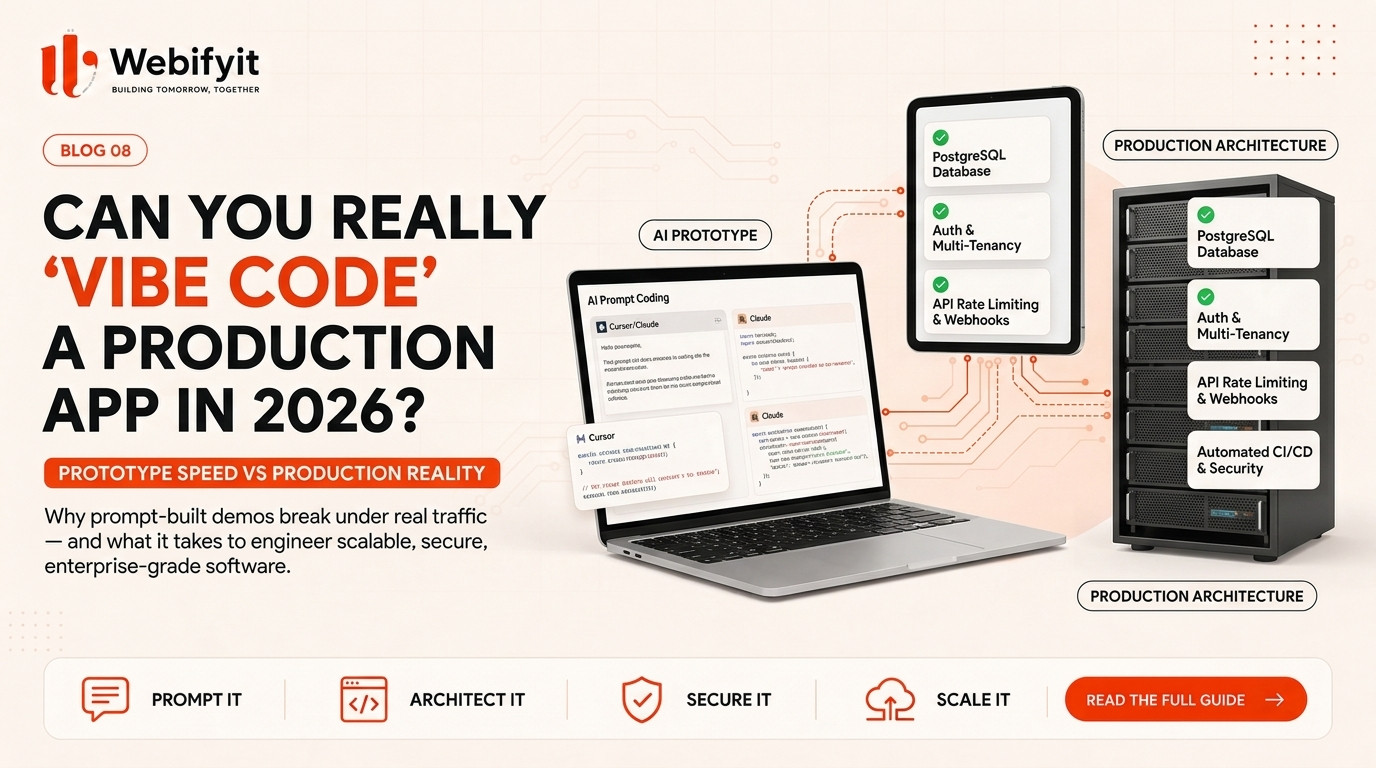
Can You Really "Vibe Code" a Production App in 2026? The Brutal Truth Behind the AI Hype
If you have spent any time on tech Twitter, LinkedIn, or YouTube in 2026, you have encountered the phrase "vibe coding."
The pitch is exhilarating:
"Throw away programming syntax. Open an AI editor like Cursor or Claude 3.7 Sonnet. Type a few plain-English prompts describing your dream SaaS, sit back with a coffee, and watch an entire full-stack application materialize before your eyes."
For non-technical founders, agency owners, and product designers, it feels like magic.
Ideas that once required a $60,000 engineering quote and four months of sprint planning can now be clicked through on a browser localhost in less than a weekend.
Founders are building working CRM prototypes on Friday and demoing them to prospective clients on Monday morning.
And let us be clear: that speed is genuine. The prototyping velocity enabled by modern LLMs is the single biggest productivity shift in software development since the advent of open-source frameworks.
But then something predictable happens.
The prototype launches.
Real users sign up.
Actual credit cards get swiped through Stripe.
Concurrent traffic spikes.
And suddenly, the "vibe-coded" application begins to unravel.
- Users start seeing each other's private account dashboards because session state was cached globally.
- The database locks up under 40 simultaneous queries because the AI generated 18 unindexed table joins inside a serverless handler.
- A payment webhook fails to fire idempotently, charging a customer four times for a single subscription.
- The founder prompts the AI: "Fix the bug where users get logged out." The AI responds by rewriting the authentication middleware, breaking role-based permissions and exposing internal admin routes to the public web.
This is the reality of software development in 2026.
You can vibe code a prototype in 48 hours. You cannot vibe code a production business system.
In this guide, we break down why the "vibe coding" paradigm breaks under production reality, examine the anatomy of prompt debt, and explain how serious companies turn AI-generated prototypes into resilient, enterprise-grade software.
The 80/20 Illusion of AI Development
To understand why AI-coded projects hit a brick wall, you have to understand the 80/20 Illusion.
When a user interacts with a modern web application, what do they actually see?
- An appealing landing page.
- A clean signup/login form.
- A dashboard with stat cards and navigation tabs.
- A modal that opens when you click a button.
- A table displaying records pulled from an API.
This visible layer represents roughly 20% of the engineering effort required to operate a reliable digital business. However, to human perception, this 20% looks like 100% of the application.
LLMs are world-class at generating this visible 20%. They have ingested millions of GitHub repositories containing Tailwind components, React hooks, and boilerplate layouts. They can spit out a slick UI component in 3 seconds flat.
The Invisible 80%
What the founder does not see—until real traffic hits—is the invisible 80% that keeps a production application alive:
| Feature Layer | What Vibe Coding Generates | What Production Requires |
|---|---|---|
| Authentication | Basic local cookies or mock JWTs | Multi-factor auth, session invalidation, token refresh rotation, CSRF protection |
| Database | Flat JSON files or unindexed tables | ACID transactions, connection pooling, indexed foreign keys, rollback migrations |
| Security & Privacy | Client-side route blocking (if (!user) return null) | Row-Level Security (RLS), tenant isolation, encrypted environment variables, sanitization |
| API Integrations | Direct fetch calls inside components | Idempotency keys, retry backoff algorithms, webhook signature verification, rate limits |
| State Management | Global mutable variables or shallow hooks | Optimistic UI updates, cache invalidation strategies, race condition prevention |
| Error Handling | Silent console.log(err) blocks | Structured observability, sentry telemetry, graceful degradation, transactional rollback |
| Scalability | Single serverless lambdas that timeout | Background worker queues (Redis/BullMQ), edge caching, asynchronous task distribution |
When you build entirely through natural language prompts, the AI solves for the immediate happy path—the single scenario where everything works smoothly with zero latency, zero edge cases, and one user on the page.
Production software is defined by how it behaves during the unhappy path.
The Anatomy of "Prompt Debt"
In traditional software engineering, developers talk about technical debt—the cost of taking shortcuts during initial development that must be refactored later.
In 2026, we have a far more dangerous phenomenon: Prompt Debt.
Prompt debt occurs when someone builds an entire system using AI prompts without actually understanding the underlying architectural decisions being made under the hood.
Here is how the vicious cycle unfolds:
Step 1: The Initial Euphoria
You prompt the AI to build a booking portal. Within two hours, you have a functional page where you can select a date, enter your name, and see a confirmation card. You feel invincible.
Step 2: The First Inconsistency
You ask the AI to add email notifications via Resend. The AI adds the email trigger directly inside the client component. It works during local testing, but your private API key is now compiled directly into the client-side JavaScript bundle, exposed to anyone who opens Chrome DevTools.
Step 3: The AI Band-Aid Cycle
A few days later, you notice that bookings made in different time zones show up on the wrong date. You prompt: "Fix the time zone issue in bookings."
The AI does not refactor the database timestamps to UTC with ISO-8601 formatting. Instead, it adds an ad-hoc local timezone offset calculation directly inside the rendering loop.
Now, another part of your app that calculates weekly revenue breaks because the date formatting changed. You prompt again: "Fix the revenue chart." The AI patches the chart with another bespoke hack.
Step 4: The Hallucination Spiral
By week three, your codebase is 6,000 lines of spaghetti code spread across disjointed files. The context window of the AI cannot hold the entire architectural mental model.
Every time you prompt the AI to fix bug A, it introduces bug B and bug C. The application becomes fragile. Any modification causes a cascade of mysterious errors. The founder is trapped in a loop of frantic prompt-engineering, burning through API credits while the app degrades.
At this point, you don't have an asset. You have a liability.
The Five Production Pillars AI Always Misses
Let us look specifically at where AI-assisted code fails in production environments.
1. Multi-Tenant Data Isolation (Row-Level Security)
Suppose you are building a B2B SaaS platform where different companies sign up and manage their internal projects.
When an LLM generates database queries, it almost always writes standard queries like:
-- What the AI writes:
SELECT * FROM projects WHERE status = 'active';
If your API route forgets to append AND organization_id = current_user_org, User A will see User B's proprietary business records.
In production engineering, data isolation is never left to the discretion of individual API endpoint handlers. We enforce Row-Level Security (RLS) directly at the PostgreSQL database engine level:
-- Production Architectural Standard:
ALTER TABLE projects ENABLE ROW LEVEL SECURITY;

CREATE POLICY tenant_isolation_policy ON projects
FOR ALL
USING (organization_id = (SELECT org_id FROM auth.users WHERE id = auth.uid()));
With RLS enabled, even if an API route has a bug or an AI forgets a filter, the database itself mathematically refuses to return records that do not belong to the authenticated user's organization. AI prompt tools rarely establish this foundational security layer unless explicitly architected by a senior database engineer.
2. Idempotency and Webhook Race Conditions
Consider payment processing. When a customer subscribes through Stripe, Stripe dispatches a webhook event (invoice.payment_succeeded) to your server.
What happens if your server experiences a momentary network hiccup and takes 4 seconds to respond?
Stripe's webhook engine assumes the delivery failed and automatically retries sending the same webhook event 3 seconds later.
An AI-generated webhook handler typically looks like this:
// Brittle AI-generated handler:
export async function POST(req: Request) {
  const event = await req.json();
  if (event.type === 'invoice.payment_succeeded') {
    await db.user.update({
      where: { id: event.data.userId },
      data: { credits: { increment: 100 } }
    });
  }
  return Response.json({ received: true });
}
Because there is no idempotency lock, both webhook calls execute concurrently. The customer receives 200 credits instead of 100, or gets charged twice. Under high transaction volume, this defect destroys financial accounting.
Production architecture requires an atomic event deduplication table wrapped in a database transaction with distributed locks.
3. Connection Pooling and Serverless Database Starvation
In modern web hosting environments (Vercel, AWS Lambda, Cloudflare Workers), every incoming HTTP request can spawn an ephemeral serverless function instance.
If 100 visitors click your app simultaneously, 100 isolated function instances spin up.
If your AI code initializes a new database connection inside every request handler:
// Naive AI code inside a serverless handler:
const client = new Client(DATABASE_URL);
await client.connect();
Your database is hit with 100 sudden, persistent TCP connections within 300 milliseconds. A standard PostgreSQL instance will immediately exhaust its max connection limit (default 100), throwing fatal 500 Internal Server Error: connection pool exhausted errors across your entire user base.
Production architecture implements connection pooling proxies (such as Supabase PgBouncer or AWS RDS Proxy) and structured singleton connection lifecycle management.
4. Background Job Asynchrony
When a user uploads a CSV file containing 5,000 email addresses or triggers an AI report generation workflow, how does your app process it?
An AI editor will often attempt to execute the entire batch operation inside the HTTP request loop:
// Dangerous synchronous processing:
for (const row of csvRows) {
  await processRow(row); // Takes 45 seconds total
}
return Response.json({ success: true });
Most cloud infrastructure platforms terminate any HTTP request that does not complete within 10 to 15 seconds. The request abruptly dies midway through, leaving your database in a corrupt, half-processed state.
Production systems decouple web requests from execution using durable asynchronous job queues (such as Redis-backed BullMQ or Temporal) with progress tracking, dead-letter queues, and automatic retry policies.
5. Schema Migrations and Zero-Downtime Deployments
When you want to add a new column or change a relationship in your database, how do you deploy it?
If you simply push code that expects the new column before the database schema has been migrated, every single user on your live application will experience runtime crashes during the 60-second deployment window.
Engineers design expand-and-contract migrations:
- Expand: Add the new column as nullable in the database.
- Deploy: Push code that writes to both old and new columns.
- Backfill: Migrate historical data asynchronously.
- Contract: Deprecate and remove the old column.
AI does not think about deployment synchronization. It generates code for a static moment in time.
The Winning 2026 Model: "Vibe Prototype, Engineer Production"
Does this mean vibe coding is useless?
Absolutely not.
Vibe coding is phenomenal for Proof of Concept (POC) and Market Discovery.
If you are an agency owner, founder, or enterprise team lead, here is the exact framework we recommend to capture maximum value without destroying your technical foundation:
### The 3-Phase Production Engineering Framework

#### Phase 1: Discovery & POC ("Vibe Code" the Frontend)
- **Scaffold rapidly:** Use Cursor, Claude, or v0 to build high-fidelity interactive UI in hours.
- **Validate early:** Test workflows with actual users, prospective customers, and stakeholders.
- **De-risk commercial intent:** Confirm product-market fit and user demand before committing to heavy infrastructure.

#### Phase 2: Architectural Blueprint (Engineered Foundation)
- **Relational design:** Model a normalized, indexed PostgreSQL schema with strict foreign key constraints.
- **Security boundaries:** Enforce Row-Level Security (RLS), multi-tenant data isolation, and cryptographic session rotation.
- **System contracts:** Map API rate limits, idempotent webhook handlers, and transactional rollback boundaries.

#### Phase 3: Production Build (Accountable Engineering)
- **Modern full-stack architecture:** Build on clean Next.js 15 App Router server actions and strict TypeScript interfaces.
- **Resilience & scale:** Implement connection pooling proxies (PgBouncer) and Redis-backed background worker queues.
- **Continuous quality:** Establish automated CI/CD test coverage, telemetry tracing (Sentry), and enterprise SLA monitoring.
1. Use AI to Discover What to Build
Use AI tools to create high-fidelity, clickable prototypes. Don't worry about clean database schemas yet. Test the user experience with prospective buyers. Prove that people actually want the feature.
2. Freeze the Specs and Involve Experienced Engineers
Once you know what users want, bring the prototype to an accountable engineering partner.
Don't ask them to "tweak the prototype." Ask them to treat your prototype as the visual specification for a robust, production-grade application.
3. Build on Clean Foundations
The engineering team establishes the secure database architecture, connection pools, authentication middleware, and CI/CD deployment pipelines. They use AI internally to accelerate development velocity—but under strict human code review and architectural governance.
This gives you the best of both worlds: the velocity of AI plus the reliability of enterprise software.
Frequently Asked Questions
Can non-technical founders really build a successful SaaS alone with AI?
They can build the initial prototype and land their first few beta testers. However, as soon as paying enterprise clients require SOC-2 compliance, data privacy guarantees, high availability, and custom integrations, professional engineering architecture becomes mandatory.
Why doesn't AI automatically write secure database code?
LLMs predict tokens based on frequency, not security auditing. The vast majority of open-source code on the internet is simple tutorial code that skips security checks for brevity. Unless an engineer explicitly prompts and constraints the model with precise architectural schemas, the AI defaults to the simplest happy-path pattern.
What is the biggest danger of launching a vibe-coded app to production?
Data leakage and silent state corruption. When session data or multi-tenant database queries lack strict isolation, users can access each other's confidential data, resulting in catastrophic brand damage and legal liability.
How does Webifyit handle AI-generated code?
We embrace AI coding assistants as productivity accelerators for our senior engineers, not as autonomous decision-makers. Every line of code, database migration, and security policy is reviewed, tested, and audited by senior human developers who take full accountability for system reliability.
The Bottom Line
AI has democratized the creation of software prototypes.
Anyone with an idea and a browser can generate a working interface.
What AI has not democratized is software accountability.
When a server crashes at 2:00 AM, an LLM doesn't wake up to debug the memory leak. When a payment processor flags your account for unhandled webhooks, an AI doesn't negotiate with your bank. When a customer demands a 99.9% uptime SLA, an AI cannot sign the contract.
Use vibe coding to dream fast, explore freely, and test hypotheses.
When it is time to build something your business and your customers can depend on, build it right.
Have a functional prototype or an AI workflow that needs production-grade engineering?
Schedule an Engineering Architecture Review with Webifyit
Published by the Webifyit Engineering Team | Webifyit